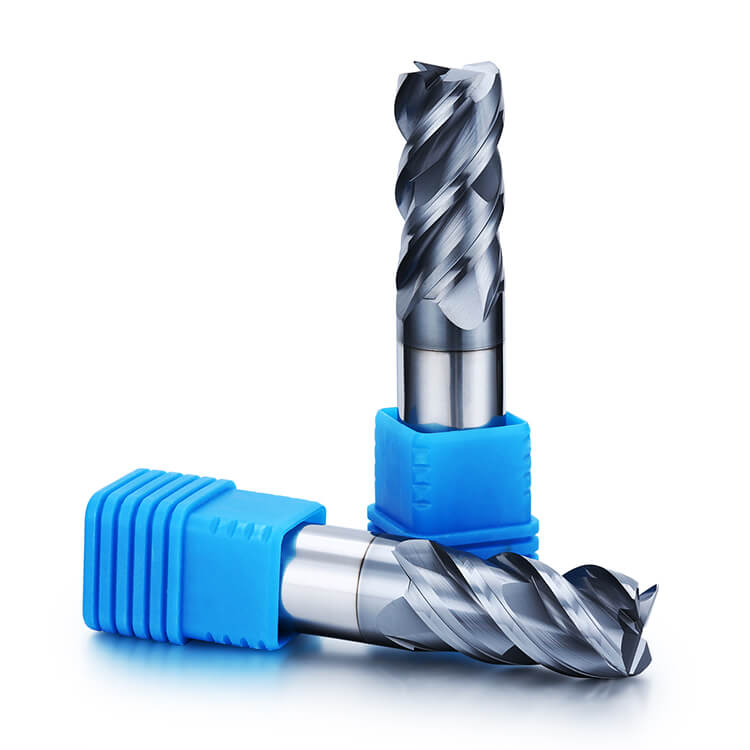
TEX Series End mill for stainless steel
TEX Square End Mill for Stainless Steel
Range reference: KVX-021
- workpiece material
- stainless steel
- application type
- Dynamic Milling; Roughing
- flute type
- Square
- Coating
- ALCRN (Balzas AP Coating)
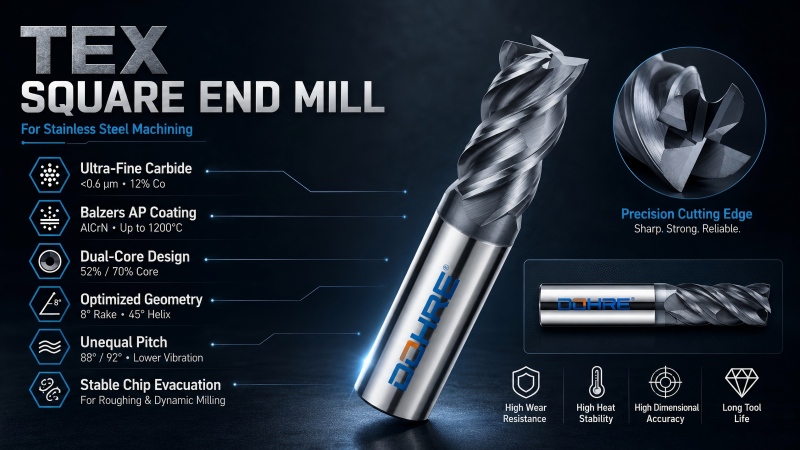
• Ultra-fine grain carbide (<0.6 μm, 12% Co) • Balzers AP (AlCrN) coating, up to 1200°C • Dual core design (52%/70%) for efficient chip evacuation • 8° rake angle, 45° helix • Unequal pitch flutes (88° / 92°) for vibration suppression • Designed for stainless steel dynamic milling and roughing
Enquire about this tool →Technical data
| Item | Range / Notes |
|---|---|
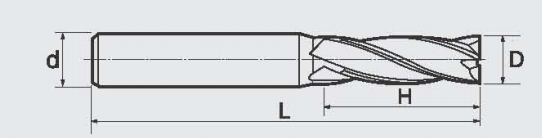
| Diameter range | 1.0 mm – 25.0 mm |
| Common sizes | Ø6 mm, Ø8 mm, Ø10 mm, Ø12 mm |
| Typical use | Dynamic milling, roughing, semi-finishing |
| Custom service | Diameter, flute length, overall length, shank size |
Additional technical data
| Machining Task | Why TEX Square End Mill Fits |
|---|---|
| Dynamic Milling | Unequal flute spacing helps manage vibration, while optimized flute geometry supports chip evacuation during variable-engagement milling. |
| Slotting | Square cutting geometry supports slot and groove machining. Cutting engagement and chip evacuation must be controlled according to slot depth and tool diameter. |
| Side Milling | Optimized cutting geometry supports machining of straight sidewalls, shoulders, and defined profiles. |
| Pocket Machining | Suitable for flat-bottom pockets and internal profiles when toolpath transitions and chip evacuation are properly controlled. |
| Roughing | Balzers AP AlCrN coating and dual-core geometry support wear resistance and cutting stability during stainless steel material removal. |
| Semi-Finishing | Controlled cutting engagement and consistent tool geometry help maintain surface quality and dimensional stability. |
Additional technical data
| Test Parameter | Recorded Value |
|---|---|
| Tool Specification | 4F-D6×15×D6×50L |
| Workpiece Material | SUS316 Stainless Steel |
| Machining Operation | End-Face Milling |
| Cutting Speed (Vc) | 94 m/min |
| Feed per Tooth (fz) | 0.15 mm/tooth |
| Axial Depth of Cut (ap) | 6 mm |
| Radial Width of Cut (ae) | 0.6 mm |
| Cooling Method | Oil Cooling |
| Machining Time | 4 hours |
| Measured Flank Wear | 0.071 mm |
Technical notes
- The KERNVEX TEX square end mill is a solid carbide cutting tool designed for dynamic milling, slotting, side milling, roughing, and semi-finishing of stainless steel, including grades 304 and 316. It features a 45° helix angle, 8° rake angle, 88°/92° unequal flute spacing, dual-core geometry (52%/70%), and Balzers AP AlCrN coating to support chip evacuation, vibration control, and wear resistance.
- The TEX Series can also be used for nickel-based alloy machining. Tool selection and cutting parameters should be adjusted according to the specific alloy grade, tool size, operation, and machining conditions.
- For a broader comparison of cutter geometries used in stainless steel machining, see our guide to stainless steel end mill types and how to choose the right one .
- The table below lists standard sizes of the KERNVEX TEX series square end mill for stainless steel machining. Custom sizes and geometries are also available based on your application requirements.
- Standard Size Overview
- Premium Carbide Material
- The TEX square end mill uses ultra-fine micro-grain carbide below 0.6 μm with 12% cobalt content . This material provides a balanced combination of hardness, toughness, and wear resistance, helping the tool maintain stable performance in stainless steel machining.
- Balzers AP Coating
- The cutter uses Balzers AP coating based on AlCrN technology , with heat resistance up to 1200°C . The coating offers strong hardness, oxidation resistance, and wear resistance, making it more reliable in high-temperature stainless steel cutting conditions.
- Optimized Dual-Core Geometry
- The tool adopts a dual-core design, with the first core opened to 52% and the second core to 70% , combined with an 8° rake angle and 45° helix angle . The smaller front core helps improve chip evacuation during roughing, remove cutting heat more effectively, and reduce the risk of built-up edge.
- Unequal Pitch for Lower Vibration
- The unequal pitch design of 88° / 92° effectively suppresses cutting vibration and improves machining stability. This makes the tool especially suitable for roughing and dynamic milling , while also helping achieve smoother cutting and more consistent machining results.
- For a wider overview of tool selection priorities, you can also read our guide to the best end mills for stainless steel .
- Applications of TEX Square End Mills
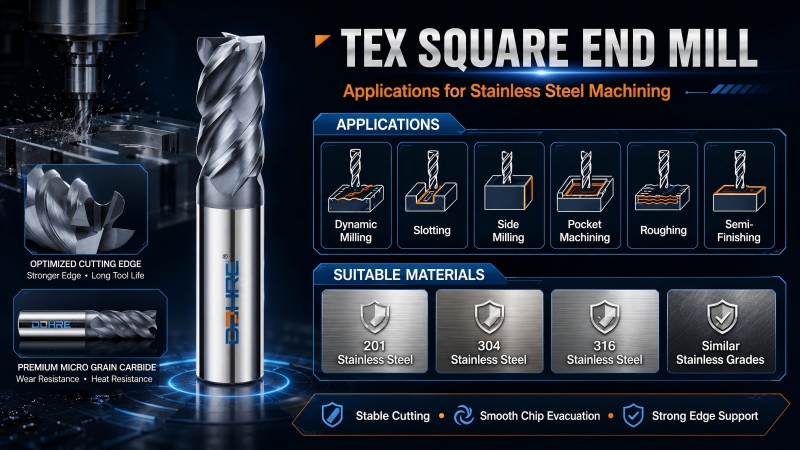
- KERNVEX TEX square end mills are designed for stainless steel milling applications where cutting stability, chip evacuation, and edge strength are important. They are suitable for common stainless steel grades such as 201, 304, and 316, as well as other stainless steels under suitable machining conditions.
- Typical machining applications include:
- • Dynamic milling
- • Slotting and groove milling
- • Side milling and shoulder machining
- • Pocket machining
- • Roughing of stainless steel components
- • Semi-finishing of profiles and flat surfaces
- Recommended Application Guide
- The TEX square end mill can be selected for different stainless steel machining operations according to workpiece geometry, material grade, and cutting requirements.
- Nickel-Based Alloy Machining
- In addition to stainless steel, KERNVEX TEX Series carbide end mills can also be used for nickel-based alloy machining. These materials are often more challenging to cut because of their work-hardening behavior, concentrated cutting heat, and high cutting resistance.
- The TEX square end mill features Balzers AP AlCrN coating, a 45° helix angle, an 8° rake angle, 88°/92° unequal flute spacing, and dual-core geometry (52%/70%). These features are designed to support cutting-edge stability, wear resistance, and chip evacuation during demanding milling applications.
- For nickel-based alloys such as Inconel, tool selection should be based on the specific alloy grade, material condition, machining operation, and machine rigidity. Cutting speeds, feeds, and engagement should be confirmed for the selected tool specification rather than taken directly from stainless steel test data.
- For application-specific recommendations, please contact KERNVEX with your workpiece material, required tool size, and machining conditions.
- SUS316 Stainless Steel Machining Test
- The following test records the machining conditions and measured tool wear of a KERNVEX TEX square end mill during SUS316 stainless steel end-face milling. The data provides a practical reference for evaluating tool performance under the recorded conditions.
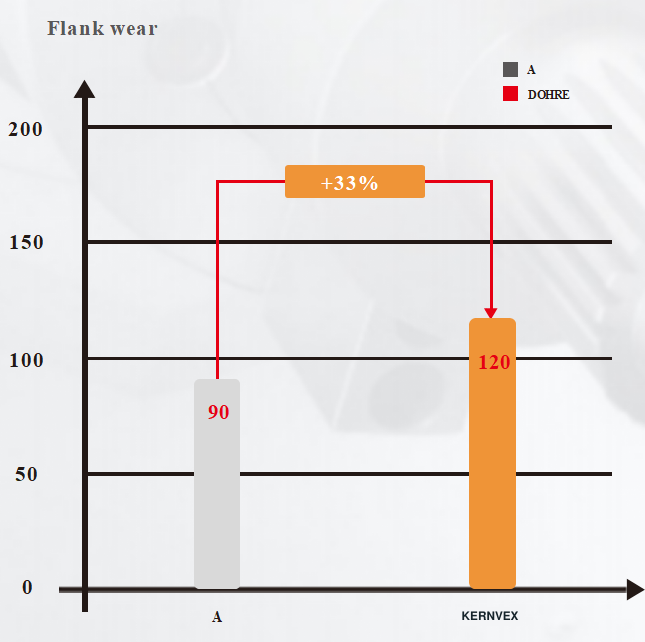
- Test Result: After 4 hours of SUS316 stainless steel milling under the recorded conditions, the measured flank wear width of the KERNVEX TEX square end mill was 0.071 mm.
- Note: This result represents one specific machining test and should not be interpreted as a guaranteed tool life or a universal cutting recommendation. Actual tool performance depends on workpiece condition, tool geometry, machine rigidity, cutting engagement, and coolant delivery.
- For more information about tool geometry, coatings, and cutting conditions, read our complete guide to selecting end mills for stainless steel .
Technical illustrations and dimension data