TEX Series End mill for stainless steel
TEX Ball Nose End Mill For Stainless Steel
Range reference: KVX-023
- workpiece material
- stainless steel
- application type
- Dynamic Milling; Roughing
- flute type
- Ball Nose
- Coating
- ALCRN (Balzas AP Coating)
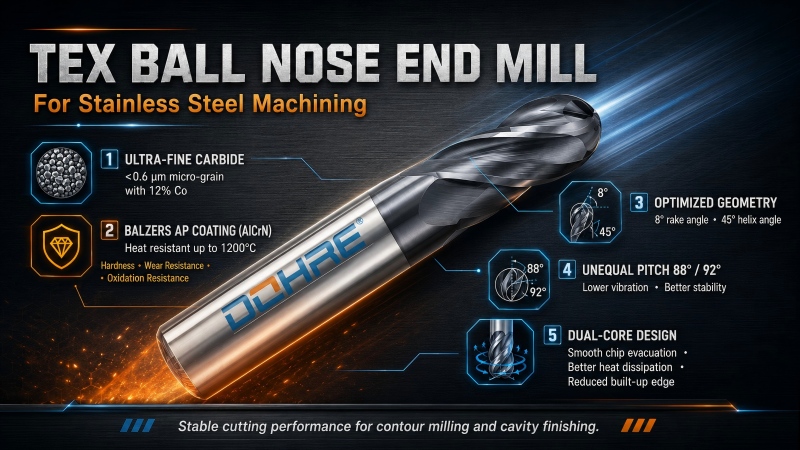
• Ultra-fine micro-grain carbide <0.6um with 12% cobalt • Balzers AP Coating (AlCrN) • 8° rake angle, 45° helix angle • Unequal pitch tooth design 88° / 92° • Dual Core Diameter Design,first core relif at 52%, second at 70% • Designed for stainless steel contouring and cavity finishing • Available in 2-flute and 4-flute designs
Enquire about this tool →Technical notes
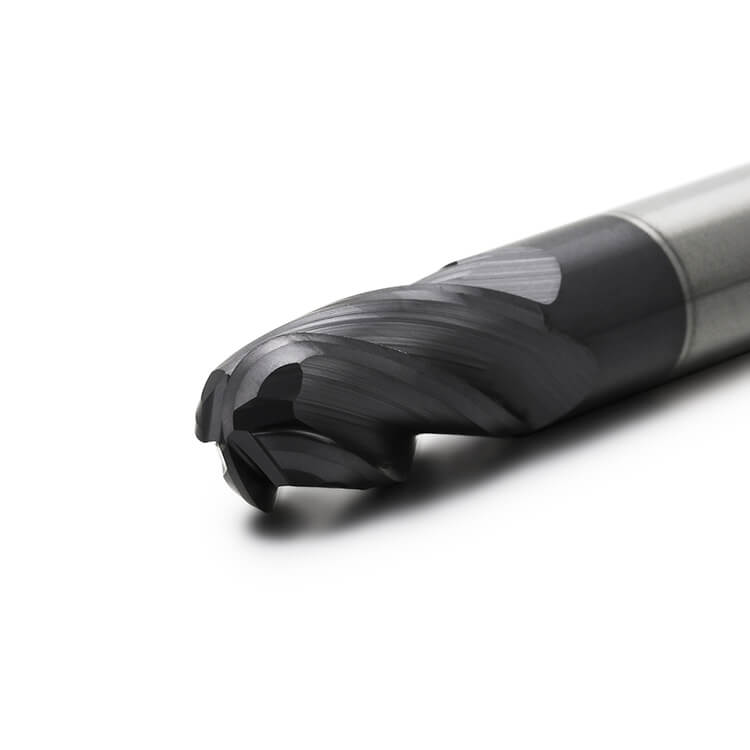
- The TEX ball nose end mill is specially developed for stainless steel machining, especially for 3D contouring, curved surface machining, and cavity finishing. Its ball nose geometry helps achieve smoother surface transitions, better contour accuracy, and more stable cutting performance in semi-finishing and finishing operations.
- Compared with square end mills, a ball nose end mill is more suitable for complex curves, cavity profiles, and detailed 3D surfaces where smooth blending and consistent finish quality are required. For a broader comparison of cutter geometries, you can also read our guide to stainless steel end mill types and how to choose the right one .
- TEX series ball nose end mills are available in both 2-flute and 4-flute designs based on different stainless steel machining requirements. Standard radius sizes are available for both fine-detail machining and large-area contour finishing.
- The TEX ball nose end mill uses ultra-fine micro-grain carbide below 0.6 μm with 12% cobalt content . This material provides a balanced combination of hardness, toughness, and wear resistance, helping the tool maintain stable performance in stainless steel machining.
- The cutter is coated with Balzers AP coating based on AlCrN technology. With heat resistance up to 1200°C , this coating offers strong hardness, wear resistance, and oxidation resistance, making it more reliable in high-temperature stainless steel cutting conditions.
- Its 8° rake angle and 45° helix angle help improve cutting smoothness and reduce cutting resistance. This geometry is suitable for stainless steel applications where stable cutting and better surface finish are required.
- The unequal tooth spacing design of 88° / 92° helps suppress vibration and improve machining stability. This is especially useful in 3D contour milling and cavity finishing where chatter can affect surface quality and tool life.
- The dual-core geometry also helps improve chip evacuation and heat dissipation, reducing the risk of built-up edge and supporting more stable cutting performance.
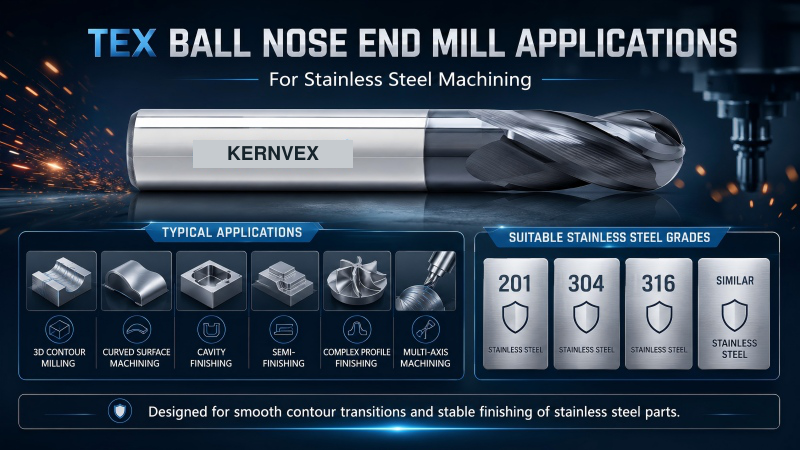
- TEX ball nose end mills are designed for a wide range of stainless steel machining applications, especially where complex geometry and smooth contour transitions are required.
- Typical applications include:
- • 3D contour milling
- • Curved surface machining
- • Cavity finishing
- • Semi-finishing of stainless steel components
- • Surface finishing of complex profiles
- • Multi-axis machining of stainless steel parts
- They are suitable for common stainless steel grades such as 201, 304, 316, and similar stainless materials used in industrial and precision applications.
- Available radius sizes range from R0.5 to R12.5 , making the series suitable for both fine-detail machining and large-area surface finishing. For a wider overview of cutter selection priorities, you can also read our guide to the best end mills for stainless steel .
- This size range is especially suitable for:
- • Fine-detail contour finishing
- • Large curved surfaces
- • Mold-like cavity profiles in stainless steel parts
- • High-precision surface blending
- • Multi-axis contour toolpaths
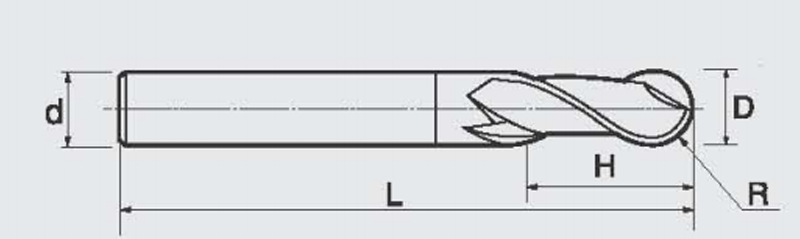
Technical illustrations and dimension data