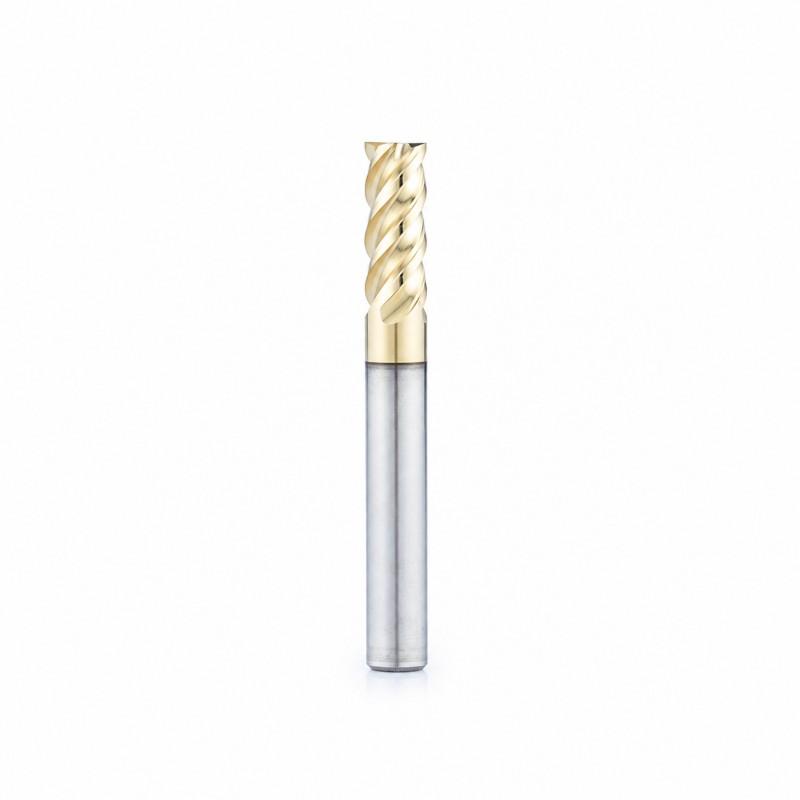
DEX Series End mill for titanium alloy
DEX Flat End Mill for Titanium Alloy
Range reference: KVX-025
- workpiece material
- Steel; Stainless Steel; Cast Iron; Nonferrous materials; Titanium alloy
- application type
- Roughing; Dynamic Milling
- flute type
- Square
- Coating
- HSR118 comparable to JZR coating
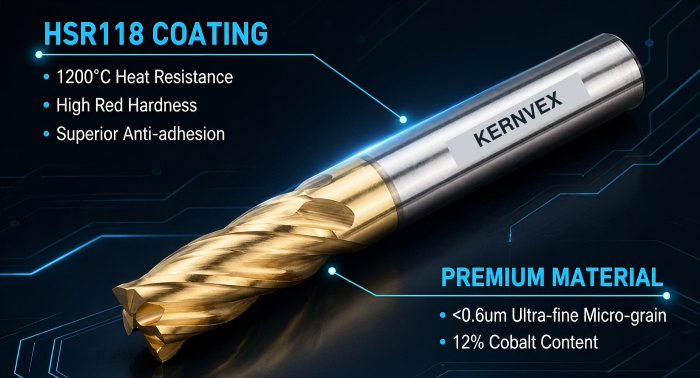
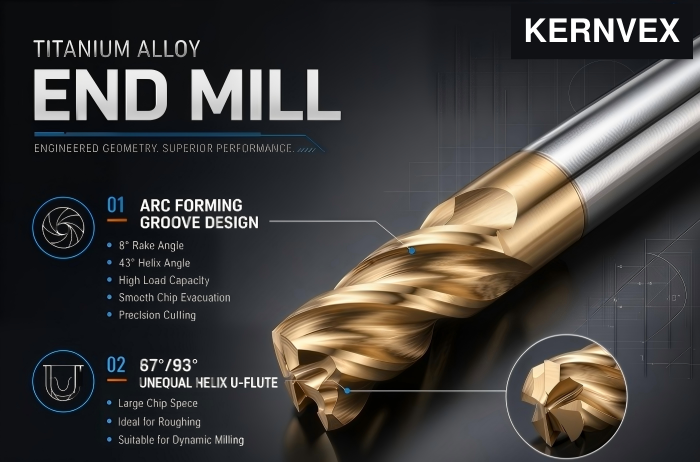
• Flat end structure for slotting, side milling, and shoulder machining • Ultra-fine micro-grain carbide (<0.6 μm) with 12% cobalt • HSR118 coating for titanium alloy machining • 8° positive rake angle for smooth cutting action • 43° helix angle to improve chip evacuation and reduce cutting resistance • Unequal helix U-shaped flutes (87° / 93°) for chatter suppression • Chip breaker groove design for higher roughing efficiency
Enquire about this tool →Technical data
| Item | Details |
|---|---|
| Product Name | DEX Flat End Mill |
| Tool Type | Flat End Mill |
| Material | Ultra-fine micro-grain carbide |
| Grain Size | <0.6μm |
| Cobalt Content | 12% |
| Coating | HSR118 coating |
| Heat Resistance | Below 1200℃ |
| Rake Angle | 8° |
| Helix Angle | 43° |
| Flute Design | Unequal helix U-shaped flute |
| Unequal Helix Angle | 87° / 93° |
| Groove Feature | Chip breaker groove |
| Workpiece Hardness | HRC25-60 |
| Main Applications | Slotting, side milling, shoulder machining, flat surface machining, dynamic milling |
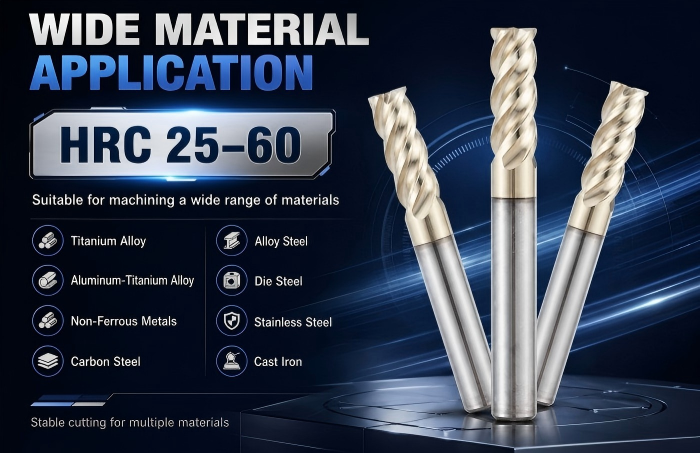
| Suitable Materials | Titanium alloy, aluminum-titanium alloy, non-ferrous metals, carbon steel, alloy steel, mold steel, stainless steel, cast iron |
| Customization | Available |
Additional technical data
| Tool Type | Best For | Main Advantage | Typical Application | Recommended Machining Stage |
|---|---|---|---|---|
| DEX Flat End Mill | Flat surfaces, side walls, step faces, shoulder machining | Sharp corner machining, efficient side milling, good versatility | Slotting, side milling, shoulder machining, flat surface finishing | Roughing, semi-finishing, finishing |
| DEX Corner Radius End Mill | High-load cutting, dynamic milling, applications requiring stronger edge protection | Better edge strength, reduced chipping, improved stability under load | Titanium alloy roughing, semi-finishing, dynamic milling, high-efficiency machining | Roughing, semi-finishing |
| DEX Ball Nose End Mill | 3D curved surfaces, cavity profiling, contour machining, arc transition areas | Smoother tool path, better surface consistency, ideal for complex profiles | Mold cavities, curved surfaces, contour milling, radius transitions, profile finishing | Semi-finishing, finishing |
Technical notes
- The KERNVEX DEX flat end mill is an HSR118-coated solid carbide end mill designed for titanium alloy machining, including Ti-6Al-4V. Its 43° helix, 8° rake angle, 87°/93° unequal flute spacing, and chip-breaker geometry help improve chip evacuation and reduce vibration during roughing, slotting, and side milling. It can also be used for thin-wall titanium finishing under suitable cutting and workholding conditions.
- The DEX flat end mill is designed for customers who need efficient and stable machining on titanium alloy and other hard-to-cut materials. Its flat end geometry makes it a practical choice for machining flat surfaces, side walls, shoulders, slots, and step faces where corner accuracy and cutting efficiency are important.
- For titanium alloy machining, tool stability, chip evacuation, and anti-sticking performance are especially critical. DEX flat end mills are developed to address these challenges through optimized material selection, advanced coating technology, and carefully designed flute geometry. They can be used for roughing, semi-finishing, and finishing depending on the machining strategy and workpiece condition.
- For a broader comparison of flat, ball nose, and corner radius cutters, see our guide to selecting end mills for titanium alloy .
- Ultra-fine micro-grain carbide material The cutter is made from ultra-fine micro-grain carbide with particle size below 0.6μm and 12% cobalt content. This provides strong toughness, good wear resistance, and reliable edge strength for demanding cutting conditions.
- HSR118 coating for difficult materials DEX flat end mills use HSR118 coating, benchmarked against JZR coating. With heat resistance below 1200℃, this coating offers excellent red hardness, stable hardness retention at high temperature, and strong anti-sticking performance. It is especially suitable for machining titanium alloy and other materials that tend to generate heat and chip adhesion.
- Optimized cutting geometry The tool adopts an 8° rake angle and 43° helix angle to improve cutting smoothness, reduce cutting resistance, and support more stable chip evacuation. This helps maintain better cutting performance under high load and difficult machining conditions.
- Unequal helix U-shaped flute design The 87°/93° unequal helix U-shaped flute design increases chip space and helps suppress vibration during machining. This is beneficial for dynamic milling, side milling, and other operations where stability directly affects surface finish and tool life.
- Chip breaker groove design The chip breaker groove design helps optimize cutting force and improve chip breaking efficiency. This supports more efficient roughing and improves cutting control, especially in titanium alloy machining where chip management is very important.
- Applications and Machining Advantages
- The DEX flat end mill is suitable for machining HRC25-60 materials, including titanium alloy, aluminum-titanium alloy, non-ferrous metals, carbon steel, alloy steel, mold steel, stainless steel, and cast iron.
- It is especially suitable for the following applications:
- • Flat surface machining
- • Side wall machining
- • Step face machining
- • Shoulder machining
- • Dynamic milling
- • Roughing, semi-finishing, and finishing of titanium alloy parts
- In practical machining, DEX flat end mills offer several clear advantages:
- • Sharp corner capability for precise shoulder and step machining
- • Efficient side cutting for walls and profiles
- • Good versatility across different machining tasks
- • Stable cutting performance on titanium alloy and difficult materials
- • Strong anti-sticking behavior at high temperature
- • Large chip space for better chip evacuation
- • Reduced vibration through unequal helix flute design
- • Better cutting force control with chip breaker groove structure
- For customers machining titanium alloy components, DEX flat end mills are a practical option when the machining target includes planes, slots, side walls, and sharp corner features.
- Thin-Wall Titanium Milling
- Thin-wall titanium components can be challenging to mill because cutting forces may cause wall deflection, vibration, and dimensional variation. Tool geometry, cutting engagement, and workholding stability must be considered together.
- The DEX flat end mill features an 8° positive rake angle, 43° helix, and unequal flute geometry designed to support cutting stability and chip evacuation. These features can be beneficial for side-wall machining when suitable cutting conditions are used.
- For thin-wall finishing, a practical approach is to leave a consistent finishing allowance after roughing, minimize tool overhang, use light radial engagement, and maintain secure workholding. Cutting parameters should be adjusted according to wall thickness, tool diameter, and machine rigidity.
- A flat end mill is suitable for defined sidewalls and flat features. For curved titanium surfaces and 3D contours, a ball nose end mill may be more appropriate.
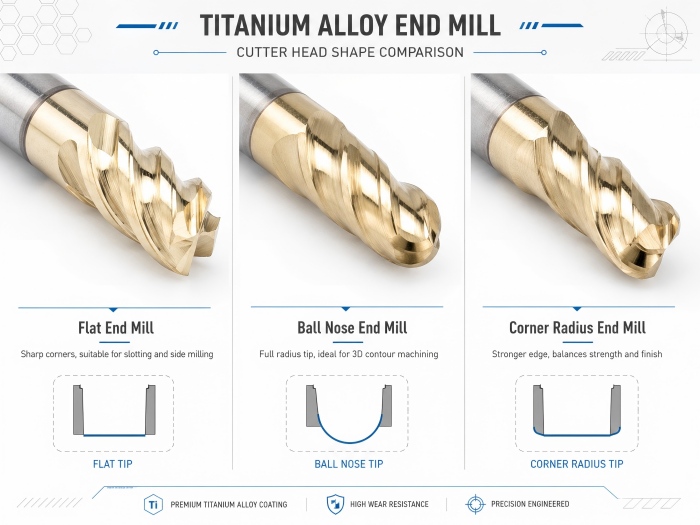
- When machining titanium alloy and other difficult-to-machine materials, choosing the right tool geometry is just as important as selecting the right coating or carbide grade. Different DEX series end mills are designed for different machining tasks.
- In simple terms, choose a DEX flat end mill when the machining focus is on flat surfaces, side walls, slots, and sharp corners. Choose a DEX corner radius end mill when higher edge strength and more stable high-load cutting are required. Choose a DEX ball nose end mill when machining 3D curved surfaces, cavity profiles, and complex contours.
Technical illustrations and dimension data