
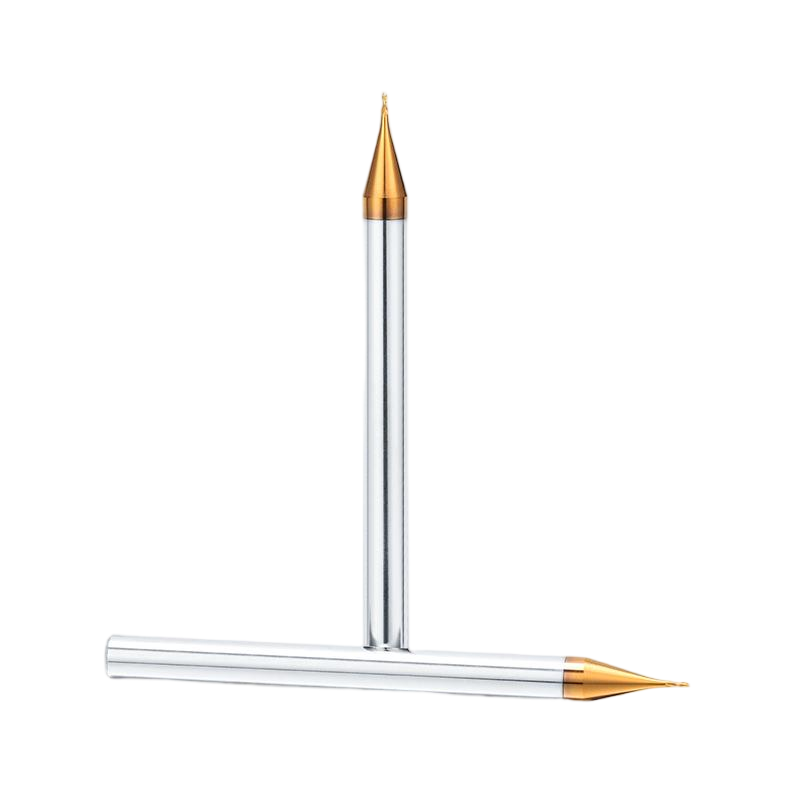
Non-standard Milling Tools
Solid Carbide Micro Flat End Mill
Range reference: KVX-037
- workpiece material
- steel; cast iron
- application type
- Finishing; Semi-Finishing; Micro Slotting; Precision Milling
- Coating
- AlTiN Nano Composite Coating; Non-coating
• Flat-end geometry for micro slots, narrow grooves, small cavities, and flat-bottom features • Short flute design supports rigidity and reduces tool deflection • 50 mm overall length with 3 mm and 4 mm shank options • Custom dimensions, coatings, and OEM batch production available
Enquire about this tool →Technical data
| Cutting Diameter (D) | Flute Length (Lc) | Overall Length (L) | Shank Diameter (d) |
|---|---|---|---|
| 0.2 | 0.4 | 50 | 3 |
| 0.3 | 0.6 | 50 | 3 |
| 0.4 | 0.8 | 50 | 3 |
| 0.5 | 1.0 | 50 | 3 |
| 0.6 | 1.2 | 50 | 3 |
| 0.7 | 1.4 | 50 | 3 |
| 0.8 | 1.6 | 50 | 3 |
| 0.9 | 1.8 | 50 | 3 |
| 0.2 | 0.4 | 50 | 4 |
| 0.3 | 0.6 | 50 | 4 |
| 0.4 | 0.8 | 50 | 4 |
| 0.5 | 1.0 | 50 | 4 |
| 0.6 | 1.2 | 50 | 4 |
| 0.7 | 1.4 | 50 | 4 |
| 0.8 | 1.6 | 50 | 4 |
| 0.9 | 1.8 | 50 | 4 |
Additional technical data
| Application Area | Typical Features |
|---|---|
| 3C Electronics | Small housings, connector openings, narrow slots, compact cavities, and precision shoulders |
| Optical Modules & CPO Components | Micro cavities, fine slots, interface features, thin walls, and small-radius areas |
| Liquid Cooling Components | Small flow-channel features, sealing grooves, connector details, and narrow precision areas |
| Mold & Die | Small mold inserts, narrow cavities, fine grooves, and detailed profiles |
| Medical & Precision Components | Small instrument parts, miniature mechanisms, fixtures, and fine-feature components |
Technical notes
- KERNVEX solid carbide micro flat end mill is a small-diameter milling cutter designed for precision machining of micro slots, narrow grooves, small cavities, flat-bottom features, and other fine details.
- Compared with standard-size end mills, micro-diameter end mills require more stable tool geometry, lower cutting resistance, controlled tool overhang, and reliable dimensional consistency. The flat end geometry produces a flat bottom and is suitable for applications where slot width, bottom accuracy, side-wall quality, and fine-feature consistency are important.
- Standard cutting diameters range from 0.2 mm to 0.9 mm. The listed tools have an overall length of 50 mm and are available with 3 mm or 4 mm shank diameters. Short flute lengths help maintain rigidity during small-diameter cutting and reduce the risk of excessive tool deflection.
- Carbide grade, coating, flute geometry, and cutting-edge design can be selected according to the workpiece material and machining requirement. KERNVEX also supports non-standard micro flat end mills based on customer drawings, feature dimensions, machining depth, and surface-finish targets.
- Custom sizes available: Other cutting diameters, flute lengths, overall lengths, shank diameters, neck dimensions, coatings, and cutting-edge geometries can be manufactured according to customer requirements.
- KERNVEX micro flat end mills are designed around the rigidity, cutting-edge quality, dimensional consistency, and low cutting resistance required in small-diameter CNC machining.
- Solid Carbide Construction
- The solid carbide construction provides the hardness and structural stability required for micro-diameter machining. A stable carbide substrate helps maintain cutting-edge geometry during precision slotting, cavity machining, and fine-feature finishing.
- Micro Flat End Geometry
- The flat end cutting geometry is suitable for producing flat bottoms, narrow slots, small shoulders, fine grooves, and compact features. It is more suitable than a ball nose end mill when the machining area requires a flat bottom or a clear bottom-to-wall transition.
- Short Flute Design for Improved Rigidity
- The standard flute length is approximately twice the cutting diameter. This compact cutting section helps reduce deflection and supports more stable machining performance when using diameters from 0.2 mm to 0.9 mm.
- Sharp Cutting Edge and Low Cutting Resistance
- Precision-ground cutting edges help reduce cutting resistance and support cleaner micro features. Lower cutting force is especially important when machining thin walls, narrow grooves, small cavities, and delicate precision components.
- Material-Specific Tool Options
- Micro end mill performance depends on the workpiece material. Carbide grade, coating, flute design, and cutting-edge preparation can be selected for steel, stainless steel, aluminum, copper alloys, mold steel, graphite, and other precision-machining materials.
- Custom Micro End Mill Support
- Custom cutting diameter, flute length, neck length, shank diameter, overall length, coating, flute number, and application-specific geometry are available for non-standard micro machining requirements.
- Solid carbide micro flat end mills are suitable for precision components containing very small slots, cavities, grooves, shoulders, and flat-bottom features. Tool selection should be based on the workpiece material, feature depth, tool overhang, machine runout, and required surface quality.
- Typical Machining Features
- • Micro slots and narrow grooves
- • Small cavities and pocket features
- • Flat-bottom precision features
- • Small shoulders and side walls
- • Fine contours and compact profiles
- • Precision trimming and light finishing
- • Small connector and interface features
- Typical Industries and Components
- Selecting the Correct Tool Option
- A micro flat end mill should not be selected only by diameter. Flute length, shank size, tool overhang, coating, flute number, machine spindle condition, and workpiece material can significantly affect tool life and machining accuracy.
- For curved surfaces and 3D profiles, a micro ball nose end mill is usually more suitable. For side-wall machining requiring stronger corner protection, a micro corner radius end mill can be considered.