Non-standard Milling Tools
Solid Carbide Long Neck Square End Mill for Deep Groove Machining
Range reference: KVX-042
- workpiece material
- Steel; stainless steel; Aluminum Alloy; Graphite; Hardened steel; Mold Steel; Titanium Alloy
- application type
- Slotting; Semi-Finishing; Finishing; Side Milling; Pocketing
- Coating
- AlTiN; TiSiN; DLC; Diamond Coating; Uncoated; Custom Coating
• Solid carbide long neck square end mill for deep grooves and recessed features • Flat cutting end for flat bottoms, pockets, shoulders, and side walls • Reduced-neck design improves clearance in hard-to-reach machining areas • Suitable for semi-finishing, finishing, slotting, and profile machining • Custom diameter, flute length, neck size, overall length, flute count, and coating
Enquire about this tool →Technical data
| Parameter | Available Configuration |
|---|---|
| Tool Material | Solid Carbide |
| End Geometry | Square / Flat Bottom |
| Neck Type | Long Neck / Reduced Neck |
| Flute Count | 2 Flutes / 4 Flutes / Custom |
| Coating | Selected According to Workpiece Material |
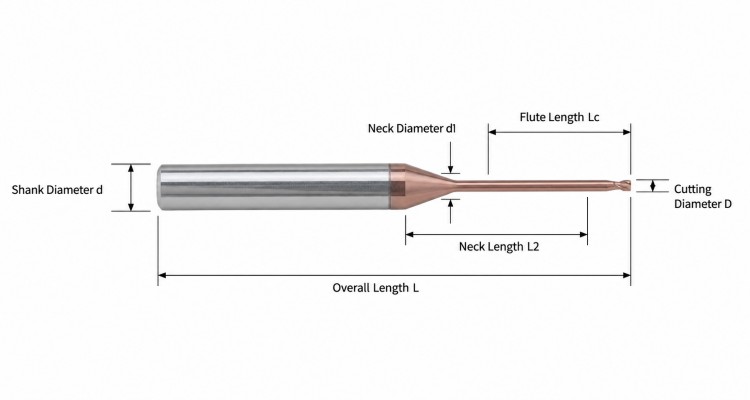
| Cutting Diameter D | Standard or Custom |
| Flute Length Lc | Customizable |
| Neck Diameter d1 | Customizable |
| Neck Length L2 | Customizable |
| Shank Diameter d | Standard or Custom |
| Overall Length L | Customizable |
Additional technical data
| Machining Feature | Role of the Long Neck Square End Mill | Main Consideration |
|---|---|---|
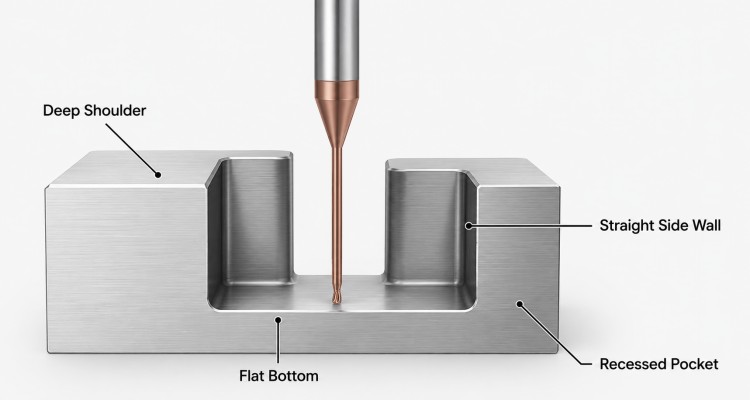
| Deep Groove | Reaches below surrounding walls while producing a flat groove bottom | Chip evacuation and minimum necessary neck length |
| Recessed Pocket | Machines pocket bottoms and internal side walls in restricted areas | Toolholder clearance and cutting engagement |
| Flat-Bottom Cavity | Produces a defined flat surface at the bottom of a deep cavity | Bottom allowance, runout, and axial cutting depth |
| Deep Shoulder | Machines the shoulder floor and adjacent vertical wall | Side-cutting stability and corner condition |
| Tall Side Wall | Provides clearance behind the cutting edge for recessed wall finishing | Radial engagement and tool deflection |
| Mold Insert Feature | Reaches narrow and recessed flat-bottom mold details | Profile tolerance and surface consistency |
| Precision Component | Machines small deep features with controlled access | Runout, overhang, and workholding rigidity |
Technical notes
- KERNVEX solid carbide long neck square end mill is designed for deep grooves, recessed pockets, flat-bottom cavities, shoulders, and side walls that cannot be reached efficiently with a standard-length cutter.
- A reduced-neck section behind the cutting flutes provides additional clearance between the tool body, toolholder, and workpiece. This allows the cutting edge to reach deep or restricted features while keeping the actual flute length relatively compact.
- Unlike a long neck ball nose end mill used mainly for curved surfaces and three-dimensional contours, the square cutting end produces flat bottoms and straight side-wall transitions. It is therefore suitable for deep slots, narrow pockets, recessed shoulders, mold inserts, precision components, and other flat-bottom machining features.
- Tool geometry, carbide grade, flute count, coating, cutting diameter, flute length, neck dimensions, shank size, and overall length can be selected according to the workpiece material and machining requirement.
- Available Tool Configuration
- How the Long Neck Design Works
- The flute section performs the actual cutting, while the reduced neck provides clearance behind the cutting edge. This structure is useful when the required machining reach is longer than the actual cutting depth.
- The neck should be only as long as necessary. An excessively long neck or unnecessary tool overhang can reduce rigidity and increase vibration, deflection, dimensional variation, and the risk of tool breakage.
- Flat Cutting End for Defined Bottom Surfaces
- The square cutting end is designed to produce flat-bottom grooves, pockets, recessed surfaces, shoulders, and steps. It is suitable where a ball nose profile would leave a curved bottom surface.
- Reduced Neck for Additional Clearance
- The reduced-neck section helps prevent interference between the tool body, toolholder, workpiece wall, and surrounding component geometry during deep or restricted machining.
- Compact Flute Length for Improved Rigidity
- The flute length can be matched to the actual cutting depth instead of extending across the entire reach. A compact cutting section helps improve rigidity compared with using an unnecessarily long flute.
- Material-Specific Carbide and Coating Options
- Carbide grade, flute geometry, cutting-edge preparation, and coating can be selected for steel, stainless steel, mold steel, hardened steel, titanium alloy, aluminum, copper, graphite, and other materials. Different material versions use different tool configurations rather than one universal geometry.
- Custom Dimensions for Deep Features
- Cutting diameter, flute length, neck diameter, neck length, shank diameter, overall length, flute count, coating, and tolerance can be manufactured according to the customer’s drawing or machining requirements.
- Suitable for Standard and OEM Supply
- KERNVEX supports trial tools, batch orders, custom tool development, laser marking, private-label production, and application-specific packaging for CNC machining companies, distributors, and cutting-tool brands.
- Long neck square end mills are selected when the machining feature requires both extended reach and a flat cutting result. Typical applications include deep grooves, recessed pockets, flat cavity bottoms, narrow shoulders, tall side walls, mold inserts, and hard-to-access precision features.
- Typical Industries
- •Mold and die manufacturing
- •Automotive precision components
- •Aerospace component machining
- •Medical and dental parts
- •Optical and communication components
- •Semiconductor equipment parts
- •Automation and robotic components
- •Custom precision machining
- Tool Selection Notes
- The longest available tool is not automatically the most suitable option. Select the shortest flute length, neck length, and overall reach that can safely access the feature.
- For full-width deep groove machining, sufficient chip space and an effective evacuation method are particularly important. For side-wall finishing, tool runout, radial engagement, overhang, and machine rigidity become more critical.
- Send the workpiece material, feature drawing, cutting depth, required reach, machine conditions, and production quantity so that the flute count, carbide grade, coating, and dimensions can be evaluated together.
Technical illustrations and dimension data